English
 简体中文
 Русский
 Español
 ไทย
 Tiếng Việt
 Bahasa Melayu
 Bahasa Indonesia
 لالعربية
 Deutsch

Coding on Metal Packaging: How CIJ Codes Survive a Full Shift
Release time:
2026-11-01
Coding on metal packaging that lasts: condensation on cans, ink choice for metal and glass bottles, and the CIJ setup plants use to keep codes readable.
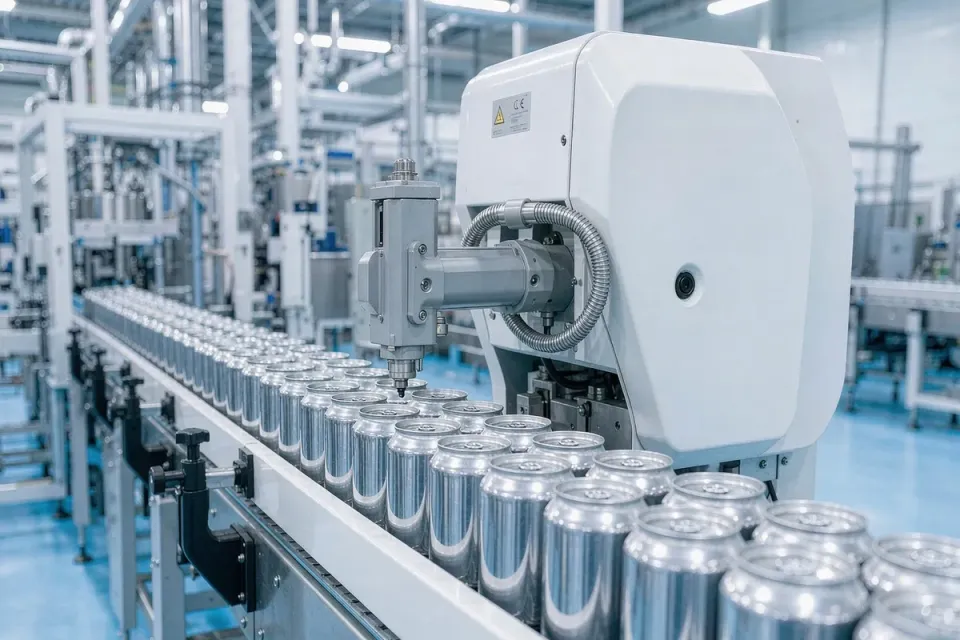
Summary: Coding on metal packaging fails quietly: a code that passes QA can vanish by the shelf. This guide covers why cans and glass are harder than they look, how condensation defeats wet-zone printing, which inks grab and hold on metal, and the placement and speed settings that keep CIJ codes readable through pasteurization.
Why Metal Packaging Is Hard to Code
Cans and metal closures look like the easiest surface in the plant. They are not. Metal is non-porous, so ink sits on top instead of soaking in, and every downstream step - pasteurization, chilling, shrink wrap, pallet friction - tries to remove it. Buyers searching for a codificador de latas usually arrive after a smudged batch, not before one. The good news: CIJ handles metal well when three variables are set for the surface instead of the brochure.
The Condensation Problem on Cans
Cans come out of the warmer wet. Codes printed on a wet wall move, feather or vanish, and they fail quietly - readable when QA checks, gone by the time the retailer scans. Plants that solve this do one of two things: code downstream of the warmer where the can is dry, or accept the wet zone and switch to a fast-set ink that bites through moisture. What they never do is print the same recipe on both zones and hope.
Ink Choice for Metal and Glass
Metal and glass share one rule: adhesion is everything. Standard MEK-based CIJ inks work on both when the line is dry; wet-can zones and cold-fill glass bottles need fast-set grades with better initial grab. Coding on glass bottles adds one twist - glass tolerates aggressive solvents, but the labels next to the code often do not. One plant swapped inks three times before anyone checked what the adhesive on their labels could survive. Test the code on the whole package, not just the substrate. VJ and DM fleets each take their own matched fluids here; mixing them is how make-up tanks end up on the service bench.
Line Setup: Placement, Speed and Code Design
Half of bad metal coding is placement. Code on the flat of the base rim where the head can hold a short throw, not on a curved wall at full speed. Match the print head speed setting to the conveyor, not the other way round - a code stretched at 40,000 cans per hour looks fine on screen and fails on the shelf. Keep the code small: a date, a lot, a line number. Every extra character adds a failure mode. And mount the head rigid; vibration on a can line is constant.
FAQ
Do we need laser for metal packaging? No. CIJ with the right ink outperforms expectations on cans and closures; laser earns its cost on permanent, high-speed marking where the substrate allows it.
How do we verify codes survive pasteurization? Print a sample run, run the full tunnel, then rub-test against the standard your retailer actually uses - not a thumb.
For more on CIJ TIJ consumables and compatible chips, browse our industry insights.
Related products:
related news


E-mail address:
Hotline:
All referenced brand names including Linx, Imaje, Domino, VJ are used solely for illustrating product compatibility scope.
Topmark has no affiliation, authorization, partnership or official endorsement with any industrial printer manufacturers.
All products offered by Topmark are third-party compatible consumables, not genuine original OEM spare parts.
No trademark ownership is claimed for any trademarks mentioned herein.